

One of the main costs in an organisation is wages and salaries. The overall staff cost includes recruitment, salary, bonus, benefits and employer national insurance contributions. There’s also the indirect cost of setting up a workspace such as a desk, phone etc. Some calculate that the total cost of an employee can be up to around 1.5 times the basic salary, so someone earning £30,000pa will cost around £45,000 to the Company.
So, if we understand the overall cost of an employee, how do we work out what it costs us when they are absent?
We also need to think about indirect costs, or those costs that are attributable but not direct employee costs, such as:
- The manager or supervisor will be spending time reallocating work or potentially cancelling orders or other work deliverables as a result.
- Temporary staff may be needed to cover, depending on the length of absence and critical nature of work. This cost will be increased if external agencies are employed.
- Training replacement staff
- A reduction in work quality
- There may be an overtime cost if other staff have to pick up more work
- There may be a morale issue if other staff are picking up work without being paid overtime it as is the case for many professional employee contracts
- Any HR costs dealing with absenteeism depending on the nature of the absence
Many calculate the total average cost of absence as:
Total cost per employee + Total cost per manager + other known costs
Simple case study example:
M has 1,000 employees. The normal working week is 35 hours.
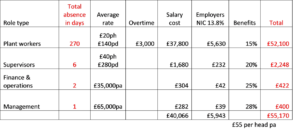
This example shows the direct cost of paying an employee who is absent at around £55 per head. This number obviously excludes the indirect costs detailed above but gives a starting point .
